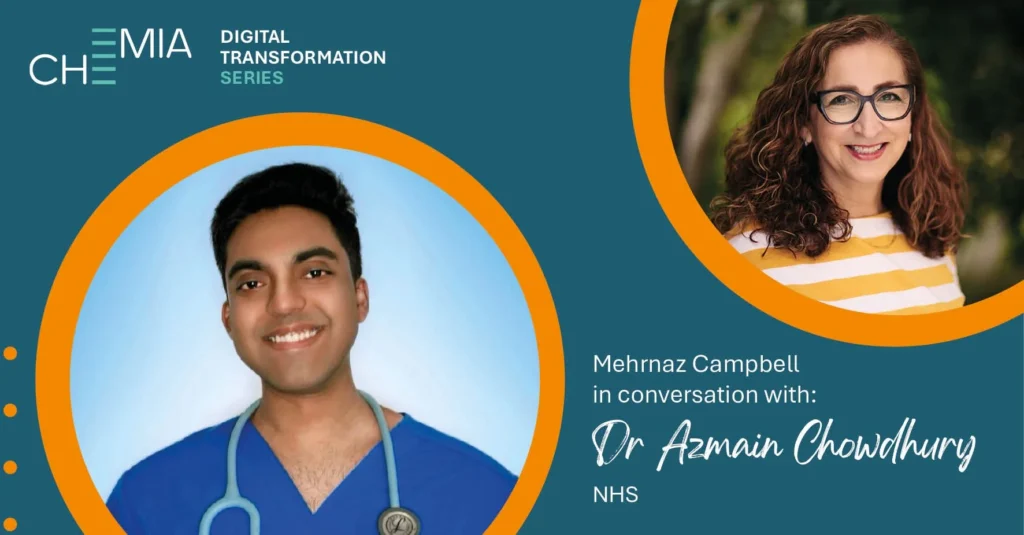

Last week I had the privilege of speaking with Dr Azmain Chowdhury, NHS GP and trusted digital voice.
Our conversation reinforced something I have been reflecting on for some time.
If you asked UK clinicians what they wish more pharma representatives truly understood, I suspect these five themes would come up again and again. Not because pharma lacks expertise, but because the NHS operating reality has shifted and engagement has not always shifted with it.
1. We are not short of information. We are short of capacity.
General practice is operating under sustained pressure. ICBs are merging, leadership roles are changing and staffing gaps remain.
In many clinics, time is the scarcest resource.
As Dr Azmain put it, “A standard GP appointment is about ten minutes. In that time you take a history, examine the patient, make clinical decisions, discuss options and complete the admin. You’re making decisions about someone’s life every ten minutes.”
In that context, more slides do not equal more value.
Before asking, “Have I explained this clearly?” perhaps the better question is, “Have I respected the reality of their day?”
Capacity is not a soft issue. It is the environment in which every decision is made.
2. Features and benefits are not the starting point. Pain points are.
Pharma often believes the solution is better articulation of data. More clinical detail. More education. More differentiation.
But clinicians do not wake up thinking about molecules. They wake up thinking about patients, targets, backlogs and system constraints.
If you start with the problem they are trying to solve, you earn the right to discuss the product. If you start with the product, you risk becoming noise.
Dr Azmain described it simply: “What moves the needle for us is simple: what is best practice for our patients, and how does this help me make better decisions in clinic?”
Relevance begins with their reality, not our message.
3. The NHS is not one customer. It is a complex ecosystem.
During a recent event, I listened to conversations about LMCs, PAs, tariff pricing, local formularies and pathway redesign. The language changes depending on who is speaking.
A GP speaks about access and appointment pressure. A hospital consultant speaks about waiting lists and service configuration. A pharmacist speaks about reimbursement and viability.
Same NHS. Very different pressures.
Pharma often has visibility across the whole pathway, and sometimes the greatest value we can add is not another message but clarity.
Helping teams understand how a decision in one part of the system affects another. Joining the dots. Not to complicate, but to simplify.
4. Empathy builds more trust than expertise alone.
Since COVID, many organisations strengthened their medical engagement, and scientific rigour matters deeply.
But empathy matters too.
Understanding that a practice partner may be worried about staffing. That a commissioning lead may be facing role uncertainty. That a clinic is running over before the day has even begun.
Dr Azmain captured the reality clearly: “The cognitive overload is intense. You’re solving a different puzzle every ten minutes for a different person, each with their own medical and social complexities.”
Even when we cannot fix system pressure, acknowledging it changes the tone of the conversation.
Connection starts there.
5. If you cannot remove system pressure, at least avoid adding to it.
Every additional form. Every poorly timed email. Every interaction that feels disconnected from local priorities.
These small frictions accumulate.
In The Omni Advantage, I often speak about relevance, timing and channel. In today’s NHS, timing may be the most underestimated of the three.
The right message, delivered at the wrong moment, still fails.
Dr Azmain made a very practical point about engagement: “Most clinicians aren’t going to read a 30-page PDF. But a short summary with links to the evidence or a quick explainer video gives us a way to meaningfully engage with the content.”
He also offered a principle that should guide the future: “Creativity and compliance should shake hands with each other.”
So the question becomes:
What would genuinely help you do your job better?
That question is far more powerful than asking:
“How do we increase reach?”
The future of pharma engagement in the UK will not be shaped by better slides. It will be shaped by better understanding.
The NHS is complex, pressured and evolving. Pharma has an opportunity to be more than a messenger. It can be a partner that understands the system, respects capacity, and aligns with real world constraints. The real question is not simply whether our proposition is strong. It is whether it makes their world easier, or harder.
I’m curious to hear from others working across the NHS and pharma.
What is one thing you wish the other side understood better about the pressures you face every day? And for those working in pharma, what have you found genuinely helps build trust with clinicians today?
If you are interested in hearing more from Dr Azmain, I will be sharing highlights from our conversation in the coming days.
Please note that the views expressed by Dr Azmain Chowdhury are his own.